Ultra Training for a Novice- The Business End

Just over five weeks to go now, and the training is starting to feel like hard graft at times. I suspect this is a good thing. Easy training certainly wouldn’t be good preparation for what is clearly going to be a hard race, so I feel fairly confident that the training is going well. That thought isn’t making it any easier.
Since I allowed myself to mentally commit to this race the thought of it has basically taken over my life, in so many more ways than I had expected. I knew that fitting in the training runs would become more time consuming as the date drew closer and the runs got longer, but in many ways that’s the small part. I find myself thinking about the race at all times of day and night, obsessing about food and fuelling, going over my kit and whether anything needs replacing, wondering what I’m going to wear on the day and what extras I’ll carry. I’m analysing my runs as never before in terms of route/distance, my pace and my calorie usage. And I’m constantly thinking about my injury and whether it’s healed enough for what I’m putting it through.

Many of these are little thoughts that flit in and out, but a few take some more serious thinking about. Whether to recce the route has been a question I’ve danced around for a few weeks, as with the race starting so close to home it is entirely possible to recce the whole thing before race day. There are obvious benefits to this: discovering and resolving any navigational issues in advance, knowing the terrain and how it changes, and being able to visualise myself on the route ahead if I’m flagging. These are benefits that may well prove vital in the latter stages of the race, when tiredness is creeping over and thought processes start to slow.

But what about the sense of adventure, of exploring somewhere new for the first time, and doing it entirely under my own steam? I accept that race conditions aren’t the ideal time for my favourite sort of exploring, the sort that involves getting stuck in at least one field, but if I’m going to run a trail race there needs to be an element of the unknown, surely?

So I’ve compromised. The final stretch is one I know well, I should have run most of the middle stretches at least once by race day, but the first eight miles will be entirely new. That feels like a fairly realistic balance. Unless the weather turns, of course. This cold but dry spring has made for ideal running conditions, but the whole route will feel very different if the wind and rain hit! These are hardly new conditions to run in, just slightly less practised than usual at the moment. Is it wrong to hope for a rainy, windy run sometime soon, just in case?
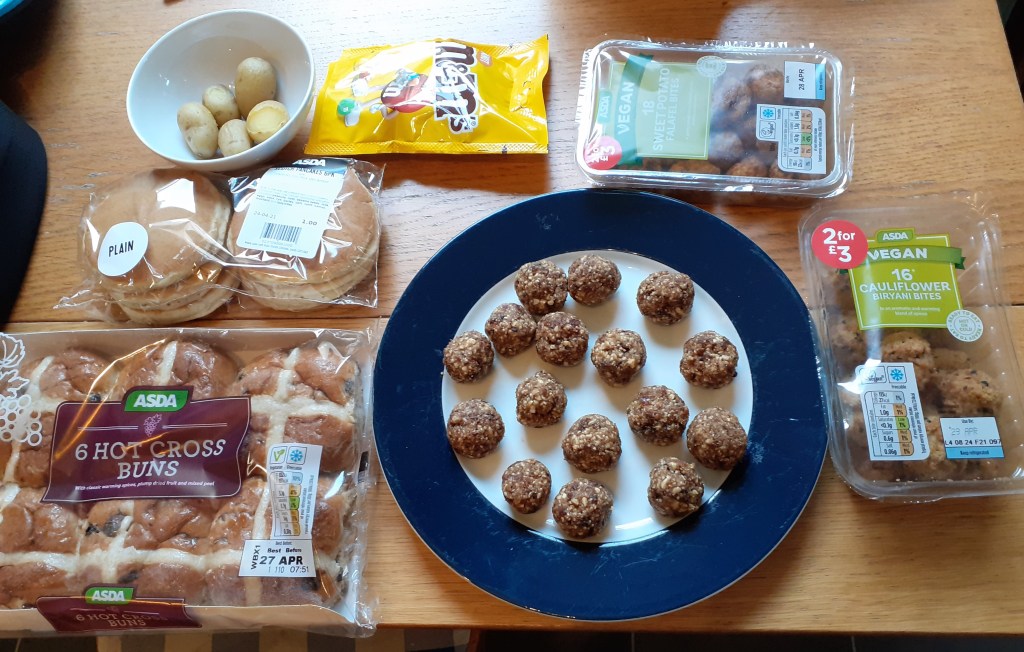
Experimenting -some options were more successful than others!

My biggest worry, as always, is fuelling. I’m still experimenting and have added pizza muffins and peanut m&ms to the raw energy balls and new potatoes I’d already discovered. I always have a stash of Shot Bloks too, just for a straight forward sugar hit, and I’m going to experiment with Tailwind this weekend as liquid calories could be a real bonus in the latter half. There is a very real chance I’ll stop to buy a Calippo somewhere en route too.

This is where my nerves are. I did a rough calculation and it looks as if I’m likely to use around 5000 calories on that run. I almost wish I hadn’t worked it out, it’s a dauntingly high number, and could far too easily become one to obsess over. Nevertheless, it helps to think about it, to plan some fuelling up before the race, not just during it, so that I have something extra in the tank if needed. I’ve also taken on board some advice from Lowri Morgan’s inspirational book ‘Beyond Limits’ – first fuel at 40 minutes, then every 20 minutes after that. Little and often should see me through.

With all this going on, is it still fun? After all, the only person making me do this is me, and there’d be very little point if I wasn’t enjoying it. The answer is a resounding yes. I’ve done some fantastic training runs, mostly with friends who are also training for the race, all bar one of us doing an ultra for the first time. The companionship and sense of community that training together has brought has been an absolute joy, and will only get more intense as the race gets closer, all our nerves kick in, and we keep each other’s spirits up to reach that starting line. Not long to go now.

Ultra Training for a Novice – there’s no going back now!

Lighthouse near Nash Point

Back in the autumn, feeling strong after all my lockdown running, I signed up for my first ultra marathon. The Vale of Glamorgan Ultra follows 40 miles of the Wales Coastal Path, from Porthcawl to Penarth, a beautiful route and, being local, one with no logistical issues to worry about. I had nine months to train, and lots of fellow novices as 12 people from my running group had also signed up. What could possibly go wrong?

Well, losing nearly three months of running to a stress fracture, followed by a very, very slow and gentle reintroduction to running wasn’t exactly ideal. Nine months of training turned into six, building up from just 1 flat mile instead of the 13 hilly ones I’d been doing pre injury. I’d be lying if I said there wasn’t a little voice that sometimes asked if this was really a sensible thing to do, but that little voice wasn’t so different to the small child repeatedly asking for ice cream, and I knew what to do with that. “We’ll see” isn’t really an answer, but it at least stops the questioning for a while.

I’ve never been one for formal training plans. There’s too much chance of life getting in the way, turning a plan into yet another source of anxiety rather than the aid it’s supposed to be. Instead, I went for small goals to tick off: managing a full 5 mile Bay loop; noticing when running started to actively help my leg feel better; running up a hill, and best of all, running back down one. None of this was ultra training, I still wasn’t mentally committing, but I was getting closer to it every time. Then at T minus three months I made it back into Penarth. Mentally that was huge, I’d got myself out of Cardiff and was starting to get some real distance in my legs. Time to accept that I really was going for this, and with that acceptance surely some element of planning would be sensible.

To my way of thinking, training of any sort breaks down into two areas: how do I get my body to achieve what I need it to do, and how do I fuel it so as to reach that goal safely? In other words, output and input.

Output

My structure has been deliberately simple: three runs a week, one of them long, and getting steadily longer as the weeks go on. It hasn’t been entirely linear – my half marathon with a friend accidentally became 14.5 miles, so I dropped back down to 12 after that – but while the distance line on the graph might be bumpy it’s definitely heading in the right direction.

But there’s more to it than simply increasing distance, I also need to look at how I run. There is no chance that I’m going to run every step for 40 miles of coastal path, so the training needs to mirror that. I need to learn how to stop and still be able to start again, how to notice when 60 seconds of power walking will refresh me rather than pushing through to keep running and risk not being able to finish. I’m learning how to spot that tiredness, thirst or hunger is going to hit, and making adjustments before it happens so that I can keep going.

Keeping going is an awful lot easier than picking yourself back up again, but I suspect I’ll need to do that too, and this one really is a head game. I find myself thinking back to my days before running, before children, and long, hard days out in the mountains. I have no doubt that this race will do just the same as some of my hardest climbs, stripping back all the layers we build over ourselves, all our protections and safety measures, until only the rawest version of our self is left. There is no hiding then, nowhere to go other than to get to the end. That exposure, that we spend so much our lives avoiding, is overwhelming when it comes. But it’s exhilarating too. I’ll know then that I’ve hit my hardest point, that it can’t get worse, that by simply putting one foot in front of the other I can keep going, and I will finish.

Input

Of course, none of that works unless our bodies have been fuelled properly, and after my brush with REDs (Relative Energy Deficiency in sport) I’m not taking any chances. I’m experimenting with different foods during a run (current favourites are Anita Bean’s raw energy balls, and cold new potatoes), and I’m making sure I eat before I get hungry, to ensure my energy levels don’t dip too much.

I’m also taking notice of the ‘calories’ stat on Strava. It’s simple common sense that the longer the run the more calories we burn, but seeing that figure written down has made me sit up and really appreciate it. My standard Bay loop can add the equivalent of a whole extra lunch to my calorific needs for the day; the 16 miles I ran yesterday almost doubled my daily need. These are not insignificant amounts of food, but it takes thinking about to properly replenish those stores, both before and after a run, and it gets harder as the distance increases.

Final steps

With a little over 8 weeks to go I’m finally allowing myself to think seriously about this race that has been on my mind for so long. I even got as far as planning weekly distances for the remaining training time, but I think that was really only to make me feel a bit better about it as I haven’t stuck to it yet! But the basics are working: my distances are growing, I’m fuelling well, and above all else I’m enjoying the training. That seems like the right place to be.