Stories and Rambles

Rediscovering my winter kit

Snowy Cardiff

It snowed on my run this morning. Not seriously to start with, just the odd white flake blown past on a bitter wind. A mile or so in the flakes vanished, replaced by tiny pellets of ice needling my cheeks and eyelids, until they too were replaced by proper snow. Big, beautiful flakes whirling around me as I ran, turning a cold, grey run into something unexpectedly magical.

There is so much joy to be found running in different weather conditions, but only when we’re properly prepared. I think I got it right this morning – warm running tights, two long sleeved base layers, a light windproof jacket, windstopper gloves, and two buffs, one round my neck and one for ears and head. I started off cold, and wondered if I’d under dressed, but a mile in I was warming up nicely and was toasty by the time I finished. Truth be told, I was probably over dressed. I certainly would have been if I’d run for much longer, but for the short I run I had in mind I was just about right.

My well worn OMM Kamleika and two buffs.

Winter makes for a hard balancing act – enough layers to keep warm and dry, but not so much as to overheat. In many ways it was the little things that were crucial today: my gloves have windstopper fabric on the outer face only, so my hands were protected but not too hot, while the two buffs kept my upper chest, ears and head warm and meant I had very little bare skin to get chilled by the wind. These are the last minute bits that are easy to forget when rushing to squeeze a run into a busy day, but without them I might well have come home cold and miserable.

As it was, being comfortable while I ran meant I could think of other things, and inevitably my mind wandered to the longer runs I’m still not able to do yet. They feel like they’re in touching distance now, so instead of just wistfully rerunning them in my mind, I find myself starting to plan. There’s something so exciting about coming home and getting my running packs out, checking them over. They haven’t seen much use since my injury back in September, but I’m not too far off needing them again.

Raidlight Responsiv 12L on a summer outing.

I suspect they’ll come out at shorter distances than they might have done in the past too. Having being rather doubtful before I tried one out, I am now fully converted. I’ve got used to the convenience of it: space to stash some extra layers, knowing if I get too hot I don’t have to run with a jacket flapping annoyingly around my waist, and having snacks and water accessible as I try to get my body more used to eating and drinking while I run. It took a bit of fiddling about in the early days to get a set up I was happy with, not least with the bottle pockets on the front of the pack. It turns out that even soft bottles are surprisingly hard when full of water, which I found extremely uncomfortable pushing against my chest, so swapping to a bladder in the main pocket at the back and using the bottle pockets for gloves, buffs and so on has worked a treat.

I’ve been checking out my waterproof too, making sure the seams are still in place and seeing whether it needs a reproof next time I wash it. This time now, when the long runs are close but not quite there, this is the chance to get my preparations right, check that my kit is fully functioning and do any repairs or adjustments. Long winter runs are surely just around the corner now, they’re so close, and I need to know I can rely on my kit when I get there.

Fuelling – Or what happens when you don’t.

In very simple terms, running requires energy and energy means food. So in order to run we need to eat. Sounds so easy, right?

Well, no, as it turns out. Eating enough is not as easy as it sounds, and the consequences of not doing so can be serious.

Lack of fuel first raised its head properly when I was training for Marathon Eryri. I was ready to do my first 20 mile run, and had a plan to run with a friend who was also doing the marathon, but after a catalogue of disasters at home that morning I set off at 11am with nothing like enough food inside me. I started to run out of energy as we got past 13 mile, and by mile 19 I just had to stop and walk a short cut home. Within five minutes of getting home I was in bed, very cold, blue lipped, and feeling very, very wrong. My very worried husband slowly coaxed tea and half a bacon sandwich into me. Eventually I had enough energy to sit up properly and eat, after which I picked up fairly quickly, but it took days to get back to normal, and unsurprisingly I got hit by a nasty cold a few days after this.

I was very lucky. There was enough time to recover from having broken myself and from the cold, and still do the marathon, which was brilliant. But there were some serious lessons to be learnt there about fuelling enough, both before and during a run. Lessons I took on board, taking plenty of water, shot bloks and other snacks with me on every long run after that. I even ran the marathon with a flapjack in my pocket!

This really should have been an end to it, I’d learnt my lesson and was looking after myself properly now. Occasionally Chris would comment that perhaps I should eat a little more after a long run, so I did, but generally I was doing ok. My long runs were getting steadily longer as lockdown progressed, getting back towards my marathon training levels, but easier and more relaxed. I was just enjoying it, and enjoying what my body seemed able to do. Then in September, nearly a year after the first time, I broke myself again. A niggle in my shin turned into a sudden sharp pain that stopped me in tracks. No quick improvement, so off to Pete the physio to sort me out. But it didn’t quite turn out like that.

We tried some rest and gentle exercises, but as it became apparent that this was something more serious Pete started talking to me about fuelling, and Relative Energy Deficiency in sport (REDs). I hadn’t even heard of it, but I started to read around and discovered that, as runners, we really need to know about this. Put simply, if our calorific intake is insufficient for our activity levels the body starts to get the energy it needs from elsewhere, potentially altering systems such as metabolism, menstrual function, bone health and immunity, among others. What makes it particularly insidious is that our running can get stronger as the body gets lighter and finds new energy reserves to use up, but none of this is sustainable. As those secondary reserves start to run low, the body becomes susceptible to stress fractures or infections and everything comes to an abrupt stop.

I’ll never know for certain whether I’ve actually had REDs, but I do know that I’ve hovered perilously close to it. The pain in my shin was never fully diagnosed, but after everything else was ruled out both my physio and GP concluded that it was a suspected stress fracture. Four months later I’m running again, but very slowly and carefully, sticking to flat, even routes that are far from the hilly trails and mountains that are my first love. And I’m so angry with myself for having landed myself in this position.

Looking back on my last few proper runs before it all went wrong, I cannot believe how badly I was looking after myself. Surely anyone can see that a 14 mile run requires more than just a normal breakfast before and standard lunch after? Surely sense says that the more we exercise, the more we eat? After all, when did you last meet a runner who didn’t look forward to cake after a long run?

Well, no, I couldn’t see it. And that is the biggest problem of all. Recreational runners are one of the highest at risk group for involuntary REDs (voluntary REDs, where athletes deliberately restrict their calorific intake is a whole other story). We don’t have coaches or dieticians to keep an eye on us, and inevitably life is hectic so we squeeze the run in, and then come home and get on with everything else that needs to be done. By the time the next meal comes along are we really thinking about how many extra calories we should be taking on board, or have we slipped back into the usual routine and forgotten that our body has worked harder than usual today? I did the latter, again and again and again, until I no longer had any thought that a long run needed special fuelling. After all, if I was chatting and enjoying it all the way round, it wasn’t really hard work, was it?

This is the lesson I am so desperate to pass on to other runners so that they can avoid this horrible, and entirely avoidable issue. As the miles slowly creep up through training, the food consumption needs to creep up too. It doesn’t need to be overly scientific, we don’t need to log every calorie, but we need to firmly embed the idea that energy output requires energy input. Running on fumes will only get us so far.

Stopping now to think about everything I’ve learnt over the last few months I realise that there is a remarkably positive spin to be put on this. Through the simple act of eating a little more as my recovery continues, and more again as the miles creep up, I have every expectation of not just completing my recovery but of being a stronger runner than I’ve every been. After all, if I’m no longer running on fumes, my running future suddenly feels exciting again. And best of all, it feels like the future might be long. That’s got to be worth a little extra thought about food.

Some useful links for more reading/listening about REDs

Recovery step 2

Now I’m starting to get somewhere. I’ve hit two significant milestones this week as I slowly edge my way back to pre-injury levels of running. There’s still a very long way to go, but I’m starting to see it, poking over the horizon as I run towards it.

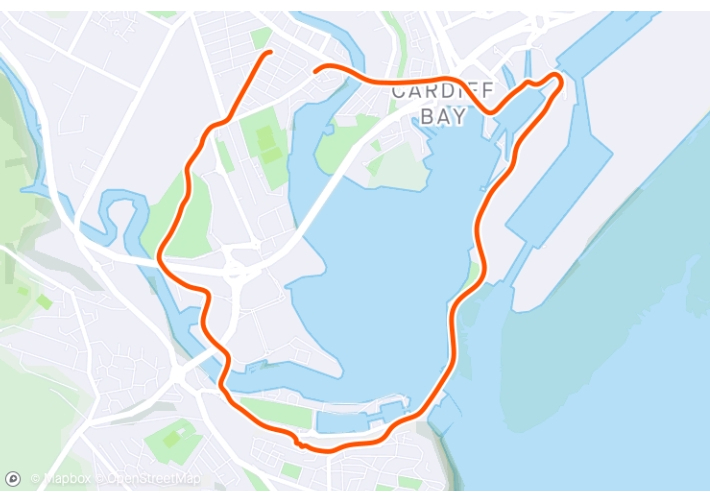
Cardiff Bay loop

Milestone 1 – I made it all the way round Cardiff Bay. This is one of those runs that has always been a benchmark, harking back to my early running days working so hard to get round it. I’d been working my way up very slowly and methodically, three runs a week then up the distance by half a mile provided the runs went well. That’s fine early on, but by the time I hit four miles the constant clock watching was getting me down – is my pace ok? Will the run be far enough? What if it’s too far, will I make it home? Add to all that the sheer tedium of running the same route every time, just because I was confident I could work out the distance, and I was at serious risk of losing my running joy.

Time for a chance of tack. Surely getting back to four miles was enough to start trusting myself again? How about choosing a shorter route, but not looking at my watch and just listening to my body instead?

Every now and then, at the most unexpected moments, we just get it right. I came back after that run feeling energised and positive so a few days later, in desperate need of a proper change of scene, I laced up, hid my watch under my sleeve, and set off for 5 miles around the Bay. At last I could run over the barrage again and feel the wind (and rain!) in my face, with the scent of the sea and the views across the Channel to keep me going. It’s something special even on a drizzly day in January, and more than ever this year after waiting so long to get back there.

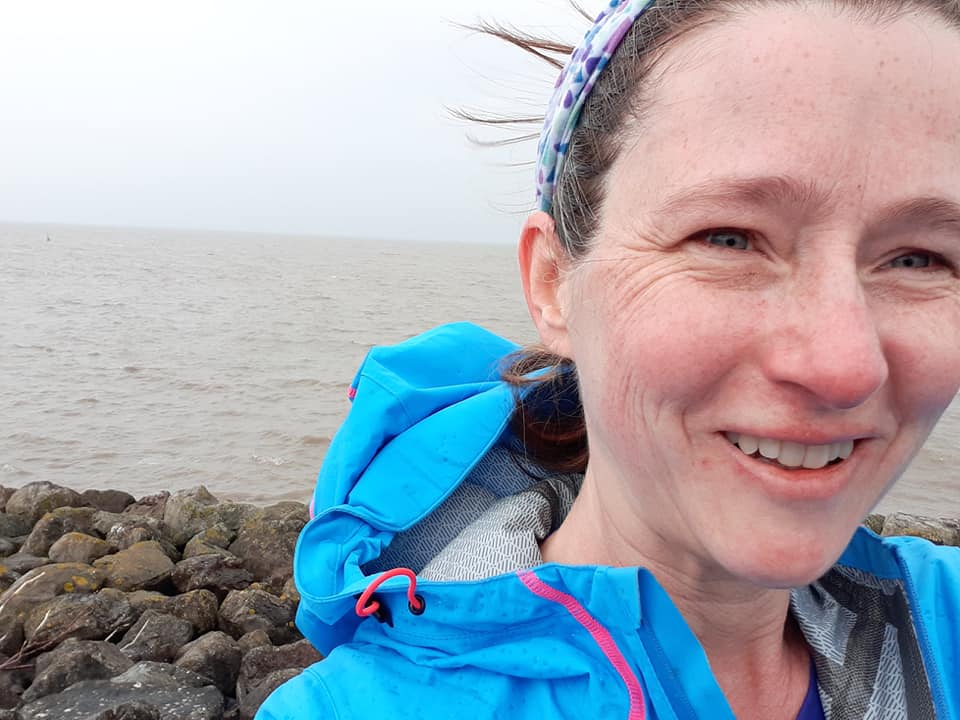
Windswept on the barrage

I may not have planned the timing, but I always knew that milestone number 1 was something I was actively working towards. Milestone number 2, on the other hand, was a completely unexpected treat. We’re still in lockdown, have been since before Christmas with no end currently in sight, so I didn’t think there was any chance of running with someone else. I’ve missed it dreadfully, the company, the chat and the camaraderie, then out of the blue today my eldest son decided to come with me, cycling next to me as I ran. I’d forgotten quite how hard running and talking can be as he chatted perfectly naturally, riding gently beside me. But I settled into it, slowly picking up the pace as I remembered how to breathe and talk, rediscovering the joy of a shared experience in the outdoors.

Recovery is a slow process, there’s no hiding from that. Even when progress is good, it takes time to build up strength and endurance again, without risking a relapse by pushing too hard, too soon. Small milestones along the way can make all the difference, achievable goals to remind us that we are moving in the right direction. Ticking off those goals and setting new ones is going to give me a focus now, a nearer focus than the big one of being back to pre-injury strength. If I’m lucky, those little goals will hide the big one for long enough to get me there without realising it.

Farewell 2020

Glad to see the back of that one, it has to be said. A year of up and downs in ways that were simply inconceivable twelve months ago, best illustrated in my Strava graph for the year.

Rather frustratingly, the start was fantastic: a muddy night race in the Forest of Dean, more muddy night runs with friends, and a fabulous run along the coastal path being just three of the highlights. But in the background this new word kept cropping up in conversation: coronavirus. As we moved into February and early March it went from occasional mention to only topic of conversation, then suddenly one of the boys was sent home from school with a cough and that was it, we were in isolation for two weeks. Within days of that happening the national lockdown began, and our world changed and shrank around us.

I’ve talked before about how running in lockdown changed my understanding of the running community around me, but it also changed how I ran. Running for sanity wasn’t new, but now there was nothing to be gained by doing my old 5k routes, even if I’d smashed by old PB (I didn’t!). Running was about escaping, escaping those same four walls, escaping the city and the walking routes we used nearly every day. And so that meant distance. For months I barely did a run under 8 miles, and if I did one, it had to be hilly. In the back of my mind I wanted to be prepared for my weekend with Girls on Hills, but these runs were also, as lockdown eased a little, my way to socialise, and I thrived on them. I even managed a run with my brother during the summer, a rare treat indeed.

It wasn’t all good. For all that I loved my weekend in Eryri, it was just that, two days. All those runs I had looked forward to in the Brecon Beacons and the Valleys had vanished, along with everyone else’s plans for 2020. Every time I thought it was safe to look ahead something came along to bite me – local lockdowns, firebreaks, then finally injury, putting paid to the entirety of the autumn.

So it is with some trepidation that I say roll on 2021. We’re still in a lockdown, my leg still hurts, there is a very long way to go. But there is hope, personally, nationally and globally. It won’t be quick, but we have the promise of vaccines to bring us back together again, and I’m starting to believe that my leg really will be healed and back to full strength this spring. 2020 brought the most incredible challenges, but we’re still here, and still running forward into 2021.

There’s the small matter of a 40 mile race in June too . . .

Girls on Hills weekend

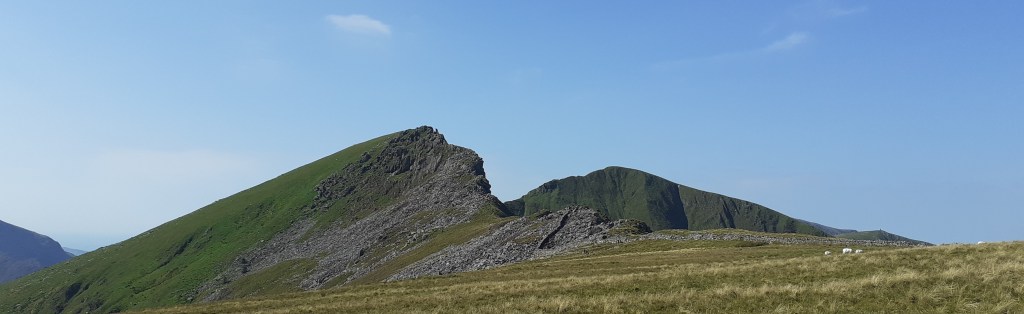
The ridge up to Mynydd Drws-y-coed

It’s December. The weather is horrible – wet and windy but still rather too mild – and my runs are still recovery runs: short, slow and flat. It becomes hard to imagine a time when runs were anything other than this, so I’ve been taking my mind off December by reminiscing about one of my highlights of 2020 – a trail running weekend in Eryri with Girls on Hills.

Map reading

Back in January I’d been feeling very low and needed something to look forward to that was just for me. Obviously it had to be running related, but I didn’t want the pressure of a race this time. I was looking for the chance to get into my happiest places, the high mountains, in as relaxed a fashion as possible. It turns out there’s a remarkable number of people and organisations offering guided trail and mountain running holidays, but the one that suited me best in terms of dates and location was Girls on Hills. They’re a Glencoe based company focusing on women in the hills, but using local guides they also offered a weekend in Eryri (Snowdonia), which was exactly what I wanted.

Llyn Padarn in Llanberis as we started out.

We met on a cloudless Saturday morning in Llanberis, four runners with a guide (Jade) and a trainee guide (Kat). I’m sure there should have been more of us, pre-Covid drop outs, but the ratio was wonderful for the clients (although less so for the business in this most difficult of years). Jade led us out of Llanberis straight up the track on to Moel Eilio, a fairly steep start to the day, but one that set us up for a fantastic run along the tops to Moel Cynghorion, than back to the Snowdon Ranger path and over the bwlch down to Llanberis. As we ran we chatted and swapped stories and experiences, running and otherwise. We talked trail vs road, how to route plan and keep safe, some techniques. Most of all we talked about confidence, how to get it and keep it, why it matters, and why it’s such a struggle for so many to find it.

Yr Wyddfa

It would have been nigh on impossible not to feel a surge of confidence running in such spectacular surroundings, with Jade and Kat encouraging us at every step. No one was left behind or held back as we ran, with regular breaks to look at the view, take photos, breath the amazing, clean air and feel renewed by it. This, to me, is exactly what trail running is all about: no pressure, just the opportunity to get into and explore some stunningly beautiful places.

Heading into the forest (photo by Jade)

We arrived back in Llanberis tired but exhilarated, bouyed up by some stunning ice cream from Georgio’s and a paddle in the lake to ease our aching feet. And easing them was crucial because the next day was all set to be even better. We’d decided to meet a little earlier as this time we were starting at the Rhyd Ddu train station to head up Y Garn and onto the Nantlle Ridge. Y Garn seems to rise straight up from the banks of Llyn y Gader so it was quite a slog up to the top, but once there we could see the rest of our route for the day, and what a route. A scramble up the ridge to Mynydd Drws-y-coed and along to Trum y Ddysgyl, a beautiful grassy slope leading to a detour to the obelisk on Mynydd Tal-y-mignedd, then down through the edges of Beddgelert Forest back to Llyn-y-Gader and the finish. Back in a previous life (before children) my favourite of all sports was scrambling, so my ultimate aim these days is sky running, and here, for the first time, I got a taste of it. Warm, grippy rock beneath my hands, the sun on my back, the smell of the mountains, my feet moving quickly over exciting terrain. This is my element, and I was totally, supremely happy.

Scrambling! (Photo by Kat)

Confidence comes from experience above all else, holding onto the memories of things we’ve achieved and knowing that we can do it again. My body remembered how to move over the rock and my mind followed, careful but not nervous, knowing that I could do this and that there is no reason not to do it again. And again. At any available opportunity.

I couldn’t possibly have asked for a better weekend. Jade and Kat opened doors I hadn’t realised I’d closed, with gentle encouragement and an absolute belief that we would finish what we’d started. Nearly six months on, I’m still smiling as I think back on it, holding on to that belief in myself and the knowledge that this injury will pass and I’ll be back out in those mountains, putting my newly remembered skills back in action.

Recovery part 1

After six long weeks with very little movement I’m back running again, and what an amazing feeling that is. So far I’ve had two very short runs, one round the local park and the other just a little way down the road and back, neither of which has topped two miles. I’m slower than I’ve been for years, I can’t even contemplate a 5K for the foreseeable, but none of that matters. I’m running again, that’s all I need right now.

Getting my kit back out.

There’s a ritual to going for a run that I’m learning to appreciate fully for the first time. The run doesn’t start when I step out the front door. It starts when I make the decision to go. From that point on, everything I do and think about is leading up to that first footstep – if I’m hungry, what should I eat that works with the run? When should I eat? Am I drinking enough, but not so much that I’ll need to stop when I’m out? And what about kit? Choosing it, laying it all out, changing. Wriggling my toes into my toe socks. Taming my hair. Lacing my shoes. Warming up and setting my watch to find the GPS.

None of this is technically running, but it all happens before the door opens and I step outside. And it is through all of this that I become a runner again, that I find that frame of mind that gets me outside and moving and loving it. The hardest part of being injured was losing this part of myself, so to find her again is an absolute joy. This is why speed and distance simply don’t matter at the moment. When I run I become my truest self, in a way that carries over into everything else I do. It makes the hard things easier to bear and the good stuff even better. I’ve really missed this. It is so, so good to be back.

Why Race?

There seems to be a fairly set pattern for a runner’s first proper race, whatever the distance: book it in advance; plan your training; talk about it to psych yourself up; learn to cope with nerves; read through the registration instructions dozens of times, and don’t get injured!

This was very much my plan when I managed to get a place in the Marathon Eryri (Snowdonia Marathon) for October 2019. There was something undeniably awesome about contemplating this iconic marathon as my first ever race, but common sense kicked in fairly quickly, and I joined some of my running mates signing up for the Brecon to Merthyr Roman Road Race. This 16 mile race follows the old Roman road through the Brecon Beacons with a significant amount of elevation along the way, and takes place some 7-8 weeks before Eryri, making it an ideal warm up. So this would be my first race instead, and an excellent training race for the marathon.

Or not.

We’d decided to spend May half term just outside the Lake District, where the weather seemed to have got stuck in February that year. After a particularly cold, wet and windy day in the fells we headed back to the house for an evening of pie and mash, with a nice, warm fire to dry us out. But as we drove back into the village we spotted a sign that hadn’t been there in the morning – ‘Caution, Runners, 7-8pm’. A race?

A quick investigation revealed that this was the annual Levens 10k, and shortly before 7pm, with a belly full of pie, I found myself on the start line. No time to think about it, no friends to run with, no specific training. And the weather was horrible. This really hadn’t been the plan.

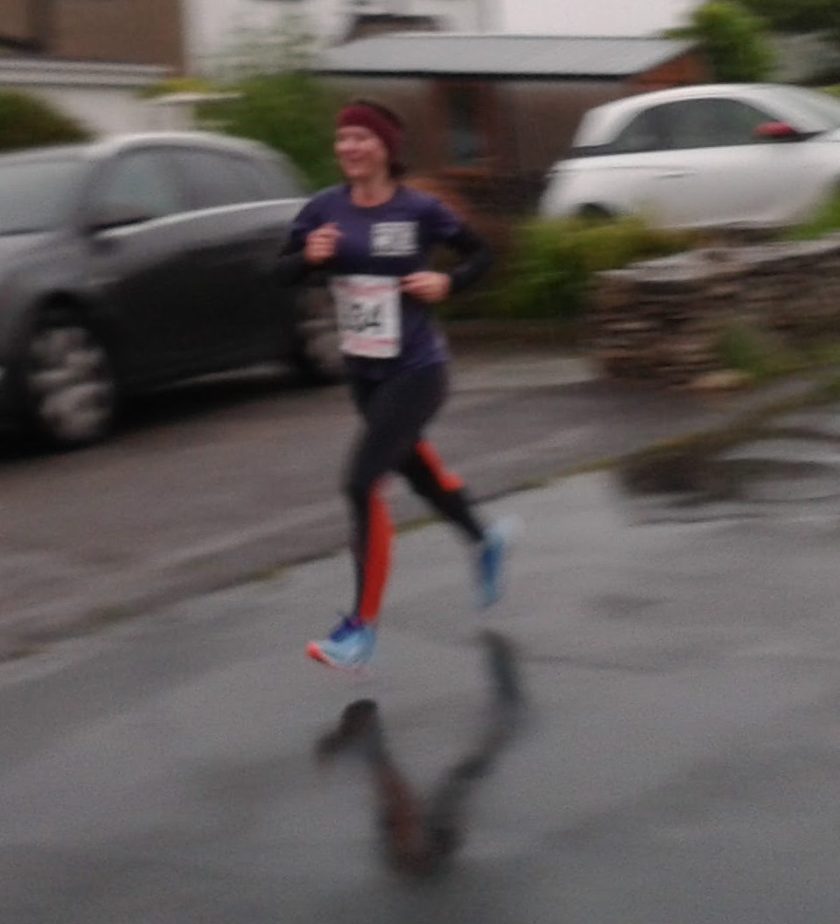
Blurred by the rain in my first race.

Maybe that’s why it was, in fact, perfect. It was a great route for me, down onto the plain for a very flat first three miles, then steeply up the hillside to run back through the beautiful Brigsteer woods. No trails, just narrow roads and wonderful views. With no preconceived plans or anxieties, without really even knowing the route, I just ran, and out came something I had thought long gone: my competitive spirit. I got pulled along by the crowd as we crossed the start line, starting much faster than I should have done. Then came the frustration at being overtaken, followed, in time, by the satisfaction of slowly overtaking people myself. Some of them I leapfrogged with for a while, but some I stayed past, and I discovered for the first time quite how energising that can be.

This wasn’t a run that needed to be a race – no need for road closures, limited marshals – which were precisely the races I’d always questioned. Why pay to run somewhere I could run anytime? Now I had an answer. A race is an event in every sense of the word, there are organisers and volunteers encouraging everyone to do their best, supporters who cheer on all the runners, not just those they know, and to top it all, a fantastic sense of being a part of something bigger, achieving just by being involved. This little, local race on a soggy May evening had opened my eyes to a whole new world.

Rain

It’s November. The days are shorter, the weather’s colder, and sunshine is in short supply. Getting motivated for a run when the world outside is grey and damp is not easy, especially when there’s a warm sofa and a good book beckoning. I could talk myself out of this very easily . . .

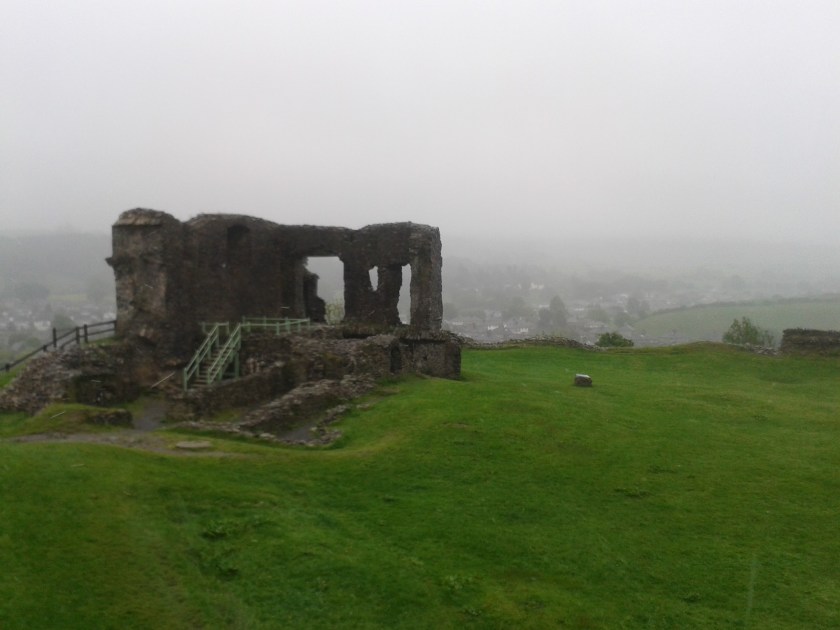
A wet and misty Kendal Castle

So why don’t I? The truth is that actually, deep inside, there is a part of me that actively enjoys going out in bad conditions. To know I’ve committed to a run in the wind and rain, when I’m going to come home looking battered and leave a puddle in the hall, gives an incredible sense of achievement. It doesn’t need to a be a long run, and it almost certainly won’t be fast, but knowing that I haven’t been beaten back by the weather is curiously empowering.

There are definitely some practical considerations here. I need to know that there’s time for a long, hot bath at the end of it, and a large mug of tea. Bad weather is not the time for running along exposed routes, with high winds more than rain playing a significant part in my route choice. This is also the time when all that techy kit comes into its own – fabrics that dry quickly are key, you don’t want to wear clothes that get so saturated they weigh you down. Unless it’s a wet day in the height of summer, a good running waterproof that is light and quiet will both keep you comfortable and get you out running for longer (I do own a very lightweight pair of running waterproof trousers, but they are very much emergency wear!). And don’t forget your feet, waterproof socks will keep your feet dry, warmer and (relatively!) cosy.

But there has to be more to it than just some practicalities that make running in the rain less awful. The first step is simple – I live in Wales, if I don’t run in the rain I’ll lose half the year, so either I embrace the weather or spend half my running life miserable. I run to make me happy, so there is no real option other than to embrace it, to open my arms and my eyes and understand that the sting of driving rain on my face is utterly exhilarating, that the downpour running off my nose and chin refreshes me better than any shower, that a steady drizzle awakens all my senses, and that the soft mizzle as I run through the mist is like a gentle kiss to remind me I’m alive.

A break in the rain on the barrage.

When I think of it like that, I can feel myself smiling at the thought of the fantastic few months of winter running ahead of me. Bring on the rain!

Running Through Lockdown(s)

It’s hard to imagine what we would have thought back at the start of the year, if anyone had suggested so many of the freedoms we take for granted would be taken away from us for such long periods this year. As I write, Wales has not long come out of a second lockdown, while England is just a week into theirs, nor can we make any assumptions that we won’t be back in one again before this whole situation is properly under control.

In a world where so much has changed you could be forgiven for thinking that worrying about something inherently self-focused is narrow minded, given the challenges so many of us have faced to work, finances, relationships, and not least health. But these are precisely the reasons why running, for me and many others, has been more important than ever. When the world shrinks to only those places you can access from your front door, running takes you further, to explore unknown places or find new variations on familiar routes. When we had no option other than to run alone, there was camaraderie to be found in seeing other runners out at the same time, and joy to be found in a friendly wave from across the road. And then we came home restored and refreshed, better able to cope with the exceptional challenges this period has thrown at us.

Green week in the Covid 19k challenge

Lockdown running opened my eyes to the benefits of an online community. For the first time in my life, I joined an online running challenge, in this case to run, walk or cycle 19k a week throughout lockdown. There were additional weekly challenges on top, to post photos of different coloured objects or scenery, different clothing items or to aim for specific route distances. So every time I went out I logged my run and found myself planning routes that would include whatever I needed each week, and then I posted them on the group’s facebook page. There were people there from all over the world, all of whom were unfailing positive and encouraging about the posts we all put up, supporting each other to get through this crisis.

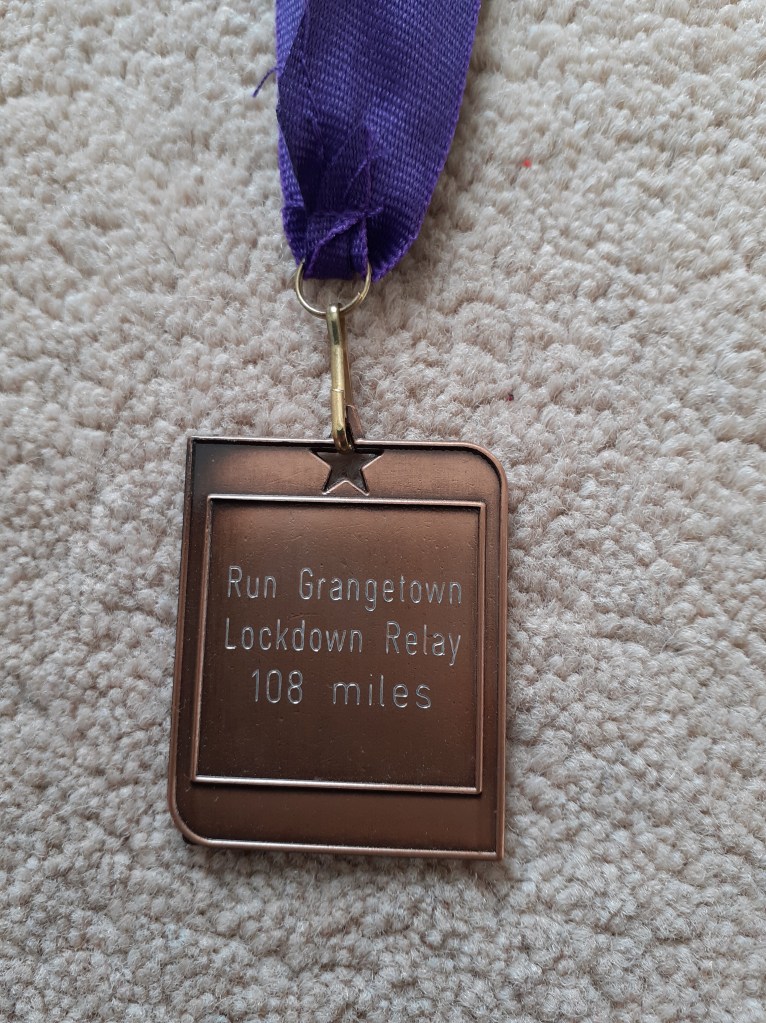
Relay medal

There was also a wonderful virtual community created from my usual running group. Our highlight was entering a virtual relay during the summer, the aim being to run as far as we could over the course of 15 hours, with one runner out at all times. We all put ourselves forward for a timed slot, from 30 minutes to two hours, with each runner starting as the last one finished. There was no requirement to pass a physical baton, only a virtual one through the clock watching, but we managed to see some of the runners in and out, and the Whatsapp group was on overdrive that day. We were in an event, all pulling together to do our best and with the most incredible sense of being part of a team even in those most unlikely of times.

This is what I’m going to try and take away from this strangest of years. Not the trauma of missing family, the stress and anxiety of so much fear and uncertainty, but the sense of togetherness I found in my running community. I have always said that I run for my sanity, but this year I learnt that it’s about more than just lacing up my shoes and going out of the door. It’s also about the people, the support we give each other, the encouragement, and the knowledge that there are people out there with whom we belong, who understand this slightly crazy fixation we have with putting one foot in front of the other and smiling while we do it.

Injured

Being injured is, to put it very mildly, rubbish. From the little niggle that makes you think you should miss a run to be on the safe side, to the stress fracture that leaves you out for months, it’s all immensely frustrating and depressing. As I write this I am recovering from what we think is a stress fracture (no one seems to be 100% sure, but as everything else has been ruled out that’s about the only diagnosis left). In many ways the timing has been as good as it could possibly be, we’ve just had another lockdown, my husband has been at home throughout, and for over two weeks I haven’t left the house and have rarely left the sofa.

Resting . . .

So I’ve been a very good girl. I’ve rested, I’m looking after myself, and as people who aren’t runners keep telling me, at least it isn’t anything worse. I’m still healthy.

Healthy?! The less I’ve done the more tired I’ve become as I’ve veered between wanting to scream in frustration at my lack of movement, and the next minute being overwhelmed by complete lethargy. Rarely has there been a time in my life when I so desperately needed to run, as we all try and find our ways to cope in this pandemic, and I can’t do it. I’m having to face up to quite how reliant I am on running. I use it to control my anxiety levels, to keep my mental health on an even keel, and over the last few years it’s become a crucial aspect of my social life. All gone. I should probably be using this time to find alternative strategies, but to do that would suggest that I might have to curtail my running, or even stop, and neither of those are even close to being options.

Perhaps it’s that last thought that has kept me on the straight and narrow throughout this period. I had always thought that I’d really struggle to stop if I found myself properly injured, but I’ve been lucky enough to have an amazing physio who was prepared to be blunt with me. He told me that if I didn’t listen to my body now I ran the risk of reaching a point where recovery became increasingly difficult, with a worst case scenario of having to stop running entirely. That prospect was such a terrifying thought that it simply hasn’t occurred to me to do anything that might risk this recovery.

I’m going to leave the house later, for the first time in 17 days. And later this week I can try a very short walk around the park at the end of our street. I can’t think too far ahead, that’s when the fear starts to overwhelm again, so one day at a time and slowly, very slowly, I will make my way back to running.